
Depuis la fin des années 2010, Hillsfar se plaît à faire parcourir à son auditoire les terres de Moonsea — l’appellation désigne autant la mer intérieure que ses territoires adjacents —, cette grande région du nord de Faerûn (ou Féérune en français), dans les Royaumes Oubliés chers aux amateurs de Donjons & Dragons. Sa nouvelle sortie, que l’artiste américain a intitulée Tides of the Moonsea, ne déroge évidemment pas à la règle. Dans son style enchanteur et très porté sur les sonorités électroniques éclatantes, Hillsfar est toujours parvenu à séduire son monde. Mais avec ce nouvel album, on lui reconnaît également un sérieux goût pour l’exploration musicale, une chose à laquelle il ne nous avait pas spécialement habitués…
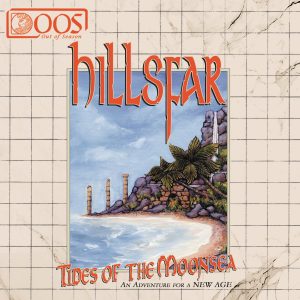 Après le Jewel, les Raiders et les Flames, voici que Hillsfar s’attaque à un territoire aquatique assumé avec Tides of the Moonsea. Comme un symbole, la pochette de ce nouvel album est agrémentée de la notion suivante, presque prophétique, « an adventure for a new age ». Vous l’aurez compris, à l’instar d’un certain Quest Master sur sa dernière sortie, Hillsfar ne se limite plus au dungeon synth. Il entend aller chercher plus loin, beaucoup plus loin, infiniment plus loin, sur le terrain très vaste offert par la musique électronique. Pour l’amateur strict d’ambiances fantastiques et imaginaires, il convient de se mouiller la nuque, et probablement que la chose ne passera pas. Mais pour les explorateurs inépuisables qui, je le sais, peuplent également la communauté dungeon synth, Tides of the Moonsea est un régal absolu.
L’album est structuré autour de neuf titres, chacun rivalisant d’inventivité et de richesse pour tenter de tirer son épingle du jeu. Autant crever l’abcès de suite, Tides of the Moonsea n’est pas un album de dungeon synth. C’est un concentré protéiforme et très coloré de ce que la musique électronique a su faire de mieux dans les années 80 et 90 — surtout 90, dirais-je avec audace, vis-à-vis du son très rond —, avec pléthore de sonorités, de mélodies et de motifs rythmiques. L’ensemble est opulent, délicieux et très accrocheur. L’album semble d’ailleurs être bâti à l’image d’une œuvre seamless, à partir duquel ont été découpés les titres visant à l’incarner. De quoi renforcer son pouvoir d’immersion.
Si l’on creuse un peu plus loin, au cœur de chaque titre, il apparaît d’abord évident que les polyphonies sont reines, mais qu’elles font partie d’un système de strates étonnamment complexe. Le premier exemple parlant concerne « Rough Waters ». On y entend d’abord une ligne grave très texturée, aux allures d’ostinato, qui imprime le mouvement du morceau. Vient s’y greffer un steelpan éclatant, dans une évocation presque immédiate de paysages côtiers, bientôt rejoint par une flûte de pan dans la seconde moitié du titre, pour ouvrir un espace plus contemplatif. Et tout ceci sans parler du volet rythmique — batterie, cloches et j’en passe — qui soutient les mélodies à merveille. Le résultat, on le constate assez facilement : un titre éblouissant, optimiste, presque candide dans la couleur de ses mélodies. Bref, un résumé parfait du contenu de Tides of the Moonsea.
Quelques paramètres viennent toutefois rappeler que Hillsfar a longtemps eu le dungeon synth pour chapelle. L’un d’eux est le titre « The Darkness Behind the Mountain ». Si l’on trouve quelques éléments sonores presque cosmiques en arrière-plan, ce sont bel et bien les cuivres retentissants — et évoquant un imaginaire épique traditionnel assez évident — qui donnent le plus de consistance au titre, pour dépeindre le château perdu plutôt que la plage abandonnée. En dehors de ces quelques composantes, l’artiste se jette à corps perdu dans tout ce qui fait le sel des compositions new age, Berlin School et même synthpop, à certains égards. Comme souvent dans la musique électronique, quelle qu’elle soit, Tangerine Dream n’est jamais très loin.
Un peu plus loin, dans la deuxième partie de l’album, Hillsfar s’appuie un peu plus lourdement sur des textures graves très prenantes. Sur « The Lost Continent », avec une certaine lenteur, et « Treasure of the Tidewater Caverns », avec bien plus d’enthousiasme, Hillsfar explore des territoires plus sombres, mais pas noirs pour autant. Le paysage sonore se montre moins fin, moins cristallin, mais il séduit tout autant que celui auquel il fait suite. D’un bout à l’autre de l’album, on sent la présence d’un artiste habité par le désir d’offrir la musique la plus dynamique et énergique qui soit. Hillsfar y arrive très bien, et ce nouvel album est déjà l’un des immanquables de l’année.
Tides of the Moonsea est trop riche pour qu’un unique article parvienne à lui rendre hommage complètement. Le voyage proposé par l’artiste américain est sensationnel, autant dans son imaginaire balnéaire rétro que dans sa capacité à s’appuyer à la perfection sur des sonorités et des motifs musicaux d’un autre temps. Faites écouter Tides of the Moonsea à n’importe quelle personne ayant vécu au moins trente ans, son imagination ira d’emblée se perdre sur quelque JRPG vintage, ou dans le décor bien plus coloré que nous offraient les années 90. Hillsfar fait référence à ces années naïves et porteuses d’une insouciance révolue. Voici tout ce que Tides of the Moonsea est capable de transmettre. On a déjà hâte de voir de quoi sera faite la suite des hostilités.
AI-generated translation. In our articles, we constantly strive to incorporate stylistic value to make our writing more vibrant and to best honor the music we analyze, but naturally, we are only capable of such a level of writing in French. Please keep in mind that some phrases and stylistic nuances might be altered by the tool.
Since the late 2010s, Hillsfar has delighted in leading its audience across the lands of the Moonsea—the name referring both to the inland sea itself and the territories that surround it—this vast region in the north of Faerûn, so dear to Dungeons & Dragons enthusiasts. The American artist’s latest release, entitled Tides of the Moonsea, naturally stays true to that tradition. Through his enchanting style and his pronounced fondness for radiant electronic sounds, Hillsfar has always managed to captivate his audience. Yet with this new album, one must also acknowledge a genuine appetite for musical exploration, something he had not particularly accustomed us to before.
After the Jewel, the Raiders, and the Flames, Hillsfar now turns his attention to decidedly aquatic territory with Tides of the Moonsea. As if by design, the album’s cover bears the almost prophetic tagline, « an adventure for a new age. » By now you’ve probably guessed it: much like Quest Master on his latest release, Hillsfar no longer confines himself to dungeon synth. He intends to venture further—much further, infinitely further—into the vast landscape of electronic music. For those who seek nothing but traditional fantasy atmospheres, it may be wise to brace themselves, for this may well prove a step too far. But for the tireless explorers whom I know also inhabit the dungeon synth community, Tides of the Moonsea is an absolute delight.
The album is built around nine tracks, each striving through its inventiveness and richness to distinguish itself from the rest. Let us address the obvious from the outset: Tides of the Moonsea is not a dungeon synth album. It is a richly colored, protean distillation of some of the finest electronic music the 1980s and 1990s had to offer—particularly the latter decade, I would boldly argue, judging by its remarkably rounded sound—overflowing with sounds, melodies, and rhythmic motifs. The whole is opulent, delightful, and irresistibly catchy. The album itself even seems to have been conceived as a seamless work, from which the individual tracks were subsequently carved, further reinforcing its immersive quality.
Looking a little deeper into each composition, it quickly becomes apparent that polyphony reigns supreme, yet forms only one layer within an astonishingly intricate system of textures. The first compelling example is « Rough Waters. » It begins with a richly textured low register that functions almost like an ostinato, establishing the movement of the piece. An exuberant steelpan soon joins in, immediately conjuring images of coastal landscapes, before a pan flute enters during the second half of the track, opening a more contemplative space. And this says nothing of the rhythmic dimension—drums, bells, and much more—which supports the melodies beautifully. The result is immediately obvious: a dazzling piece, optimistic, almost innocent in the colors of its melodies. In short, a perfect summary of everything Tides of the Moonsea has to offer.
A few elements nevertheless remind us that Hillsfar long considered dungeon synth his artistic home. One such example is « The Darkness Behind the Mountain. » While faintly cosmic sounds linger in the background, it is unmistakably the resounding brass—evoking a rather traditional epic imagination—that gives the piece its greatest substance, painting the image of a forgotten castle rather than a deserted beach. Beyond these few elements, however, the artist throws himself wholeheartedly into everything that defines new age, Berlin School, and even, in some respects, synth-pop composition. As is so often the case in electronic music, whatever its form, the shadow of Tangerine Dream is never far away.
Further into the album, Hillsfar leans more heavily on engrossing low-end textures. On « The Lost Continent, » with measured restraint, and « Treasure of the Tidewater Caverns, » with considerably greater exuberance, he explores darker territories, though never truly bleak ones. The sonic landscape becomes less delicate, less crystalline, yet remains every bit as captivating as what came before. From beginning to end, one senses an artist driven by the desire to create the most vibrant and energetic music possible. Hillsfar succeeds admirably, and this new album already stands among the year’s essential releases.
Tides of the Moonsea is simply too rich for a single article to do it full justice. The journey offered by the American artist is nothing short of sensational, both in its retro seaside imagination and in its flawless command of sounds and musical motifs from another era. Play Tides of the Moonsea to anyone who has lived through at least three decades, and their imagination will almost immediately wander toward a vintage JRPG, or back to the far more colorful world the 1990s once offered us. Hillsfar reaches back to those naïve years, filled with a carefree spirit that has long since vanished. That is everything Tides of the Moonsea manages to convey. And already, we cannot wait to discover what comes next.
