
Moins de deux ans après la sortie du très bon Vessels by Which the Devil Is Made Flesh, Misotheist refait parler de lui avec De Pinte — titre qui utilise stylistiquement le norvégien pour désigner « Les Tourmentés ». Persistant à évoluer dans son registre favori — un black metal ritualiste et enveloppant inspiré de la scène orthodoxe et du nidrosian black metal —, le projet norvégien revient clamer son antichristianisme avec beaucoup de conviction. Porté par une production limpide et un rythme sans temps morts, De Pinte semble déjà s’imposer comme l’une des sorties marquantes de ce début d’année en matière de black metal.
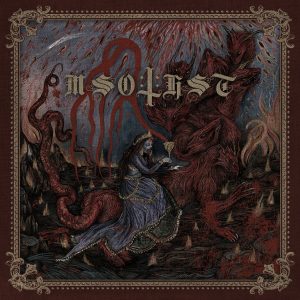 En octobre dernier, à l’occasion de la sortie de la compilation Terratur Compendium MMXXV, Misotheist a dévoilé l’un des quatre titres de ce nouvel album, « Blinded and Revealed ». Au passage, ce single se pare alors d’une pochette — du moins sur les plateformes de streaming — autrement plus élégante et dérangeante que celle qui illustre De Pinte. Comme quoi, Blut Aus Nord et son « Shadows Breathe First » n’ont pas été les seuls à s’en rendre coupable dernièrement. Ce teasing en bonne et due forme aura eu le mérite de faire saliver l’auditoire de Misotheist, dangereusement mis en appétit par ce titre riche, conséquent, qui se démarque par son rythme infernal et son atmosphère suffocante.
Pour ce qui est de De Pinte dans son entièreté, on entre dans le vif du sujet dès « Unanswered Thrice », avec une introduction angoissante à souhait, bâtie à partir de plages ambient que n’aurait pas reniées Dark Ages, et au-dessus de laquelle viennent se greffer des incantations d’outre-tombe parfaitement effroyables. Très vite, on met un pied dans ce climat saturé au possible, où règnent les riffs effrénés et la batterie dont rien ne ralentit le rythme. Cette agressivité endémique n’empêche pourtant pas Misotheist de se montrer aérien à l’envi, et ce premier titre est un bel équilibre entre cadence infernale et hommage, toujours, à une conception presque céleste du black metal.
Dans cet ordre d’idées, les chants sont un élément sonore qu’il est fascinant d’explorer. Parfaitement maîtrisés de bout en bout, les éructations de notre artiste laissent à voir un spectre étonnamment large, allant des chants éraillés propres au black metal — quoique, là encore, évoluant facilement du grave à l’aigu — à cette espèce de registre déclamatoire qui est du plus bel effet dans le style choisi par Misotheist pour transmettre sa vision de la religion. Les élévations plaintives de « Kjetterdom » en sont un très bel exemple, au cœur d’un titre plus contemplatif que les autres.
Dans un registre un brin différent, on trouve le titre éponyme, qui occupe la dernière place de la tracklist, mais qui représente à lui seul plus de la moitié de l’album auquel il donne son nom. La perspective de faire traîner un titre pendant plus de vingt minutes permet à Misotheist de le rendre incroyablement consistant. On y trouve une introduction à rallonge, des pics de violence jubilatoires, et surtout, une fin en apothéose qui intervient après plusieurs longues minutes de dévotion sourde pour l’idole de malice à laquelle le projet norvégien décide de se vouer. Ainsi est clôturé un album très réussi et auquel on revient souvent, pour continuer à s’abreuver de la fureur frénétique dont Misotheist se fait le héraut.
Digne représentant de la scène nidrosian — et produit qui plus est chez Terratur Possessions —, Misotheist commence à se faire un nom sacrément clinquant, au pays des fjords comme au-delà de ses frontières. Dans son registre ouvertement ésotérique, le projet parvient à un équilibre admirable entre considérations spirituelles et agressivité débridée. De quoi faire de son quatrième album longue durée l’une des sorties à ne pas manquer en ce début d’année.
AI-generated translation. In our articles, we constantly strive to incorporate stylistic value to make our writing more vibrant and to best honor the music we analyze, but naturally, we are only capable of such a level of writing in French. Please keep in mind that some phrases and stylistic nuances might be altered by the tool.
Less than two years after the release of the excellent Vessels by Which the Devil Is Made Flesh, Misotheist makes itself heard again with De Pinte — a title that stylistically uses Norwegian to designate “The Tormented.” Continuing to evolve within its favored register — a ritualistic and enveloping form of black metal inspired by the orthodox scene and nidrosian black metal — the Norwegian project returns to proclaim its anti-Christian stance with great conviction. Driven by a clear production and an unrelenting pace, De Pinte already appears poised to stand as one of the notable black metal releases of this early year.
Last October, on the occasion of the release of the compilation Terratur Compendium MMXXV, Misotheist unveiled one of the four tracks from this new album, “Blinded and Revealed.” On that occasion, the single also appeared — at least on streaming platforms — with a cover far more elegant and disturbing than the one illustrating De Pinte. It seems Blut Aus Nord and its “Shadows Breathe First” were not the only ones recently guilty of such a choice. This proper teaser had the merit of whetting the appetite of Misotheist’s audience, dangerously enticed by a rich and substantial track distinguished by its infernal pace and suffocating atmosphere.
As for De Pinte in its entirety, the album gets straight to the point with “Unanswered Thrice,” featuring an introduction as unsettling as one could wish, built from ambient passages that Dark Ages would not have disowned, over which perfectly dreadful otherworldly incantations are grafted. Very quickly, one steps into this thoroughly saturated atmosphere, where frenzied riffs and a relentless drum performance reign supreme. Yet this endemic aggression does not prevent Misotheist from soaring whenever it pleases, and this opening track offers a fine balance between infernal cadence and, once again, homage to an almost celestial conception of black metal.
In this regard, the vocals constitute a sonic element that proves fascinating to explore. Perfectly controlled from beginning to end, our artist’s eruptions reveal a surprisingly wide spectrum, ranging from the rasping vocals typical of black metal — though here again easily shifting from low to high registers — to a declamatory style that proves remarkably effective within the aesthetic Misotheist has chosen to convey its vision of religion. The plaintive elevations heard in “Kjetterdom” provide a fine example of this, at the heart of a track more contemplative than the others.
In a somewhat different register lies the title track, which occupies the final position in the tracklist yet alone accounts for more than half of the album that bears its name. The decision to stretch a single piece over more than twenty minutes allows Misotheist to make it incredibly substantial. One finds an extended introduction, jubilant peaks of violence, and above all a climactic ending that arrives after several long minutes of muted devotion to the idol of malice to which the Norwegian project has chosen to devote itself. Thus concludes a highly successful album to which one returns often, eager to keep drinking from the frenzied fury for which Misotheist stands as herald.
A worthy representative of the nidrosian scene — and moreover released through Terratur Possessions — Misotheist is beginning to carve out a striking name for itself, both in the land of the fjords and beyond its borders. Within its openly esoteric register, the project achieves an admirable balance between spiritual considerations and unbridled aggression. Enough to make its fourth full-length album one of the releases not to be missed at the start of the year.
