
Muets depuis la sortie de leur premier album longue durée, A-dreñv ar vrumenn, en mai 2018, les Bretons de Möhrkvlth ont de nouveau fait parler d’eux au printemps. Passé chez Antiq Records pour l’occasion et dans une certaine logique — le label se faisant fort d’être le relais privilégié en matière de black metal à relents médiévalisants ou pagan —, le groupe a dévoilé Gwenojennoù an ankounac’h, un nouvel album longue durée qui entend bien récompenser la patience de ses suiveurs. Et on peut avancer sans trop se mouiller que Möhrkvlth a de nouveau fait le nécessaire pour continuer à dépayser son monde…
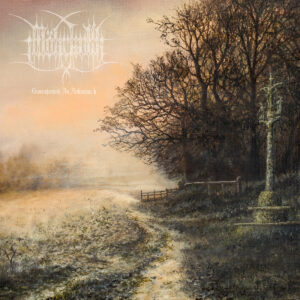 Gwenojennoù an ankounac’h — que l’on peut traduire par quelque chose comme « Les sentiers de l’oubli » — se pare d’une très belle pochette riche en couleurs pastel, peinte sur toile. On y voit un calvaire séculaire sur la droite, adossé à une forêt hivernale dégarnie, alors que la partie gauche de l’artwork est beaucoup plus lumineuse. On y devine d’ailleurs le magnifique logo du groupe, tout en discrétion. L’ensemble est infiniment plus lumineux que la pochette du dernier album, A-dreñv ar vrumenn, qui se distinguait surtout par son brouillard persistant et par ses tons gris. J’aime à croire qu’il n’est pas anodin de voir les Bretons se tourner vers des considérations plus éclatantes, et cela se ressent dans ce qui fait le sel de ce nouvel album.
Fort d’un line-up presque intégralement revu — à l’exception notable de Vox T. à la guitare —, Möhrkvlth s’est fait le géniteur d’un black metal très contemplatif, riche en riffs marquants et en ambiances soignées. Les premières minutes de « Dindan Gouloù ar C’hroajoù Mein » sont un modèle du genre : les riffs sont saillants, la batterie rapide, mais l’on apprécie en fond sonore ce climat un brin aérien très prenant, soutenu à la perfection par des chants clairs d’une gravité saisissante. Dans l’ensemble, chacun a l’occasion de profiter de titres longs et denses — seul l’interlude « Recueillement » affiche une durée inférieure à sept minutes. La principale force de l’album réside justement dans son épaisseur, dans son goût pour les atmosphères travaillées et dans le rôle consistant joué par chacun des instruments.
Il serait pourtant assez malvenu de ranger Gwenojennoù an ankounac’h dans le seul giron du black metal atmosphérique, tant Möhrkvlth conserve tout au long de l’album une certaine rugosité. Les guitares ne se contentent jamais de tapisser gentiment l’arrière-plan et certains riffs se montrent même étonnamment râpeux, presque revêches, sans jamais mettre à mal la dimension contemplative de l’ensemble. C’est probablement là que l’on trouve une bonne partie des ingrédients de la réussite de ce deuxième album longue durée : il sait installer ses ambiances sans verser dans les facilités parfois sirupeuses inhérentes au registre. Le très réussi « Dindan Gouloù ar C’hroajoù Mein » l’illustre parfaitement, nous l’avons vu, mais je veux également retenir « Aux Songes de l’Hiver » et son introduction en mid-tempo à la fois sinistre et accrocheuse. De quoi clore l’album avec une dignité très naturelle.
De la même manière, l’étiquette pagan me semble ici un peu difficile à défendre autrement que par les thèmes abordés. Gwenojennoù an ankounac’h est profondément breton dans ce qu’il raconte et dans l’imaginaire qu’il convoque, mais ne cherche pas pour autant à multiplier les artifices pour le rappeler à chaque instant. Möhrkvlth y parle de guerre, de sacré, du monde rural, de paysages et d’une certaine mémoire appelée à disparaître. Il en ressort finalement quelque chose d’assez pudique dans sa manière de mettre à l’honneur la culture bretonne, sans folklore tapageur ni exotisme opportuniste. Et pour le Lillois enfiévré que je suis, prompt à regarder tout cela depuis un coin où l’identité flamande rêve de se targuer d’un dixième du rayonnement de celle de la Bretagne, cette retenue n’est probablement pas la moindre des qualités de l’album.
Il y a huit ans, A-dreñv ar vrumenn ne m’avait pas laissé un souvenir impérissable, ce que j’ai du mal à m’expliquer, ses critiques ayant été très positives dans l’ensemble. Je suis autrement plus séduit par Gwenojennoù an ankounac’h, qui accompagne quasiment toutes mes journées de fin d’été en ce moment. L’attente a été récompensée. Ces huit années disent probablement quelque chose du chemin parcouru par Möhrkvlth, mais il faut admettre que cette période a été féconde. On peut affirmer sans sourciller que Gwenojennoù an ankounac’h va s’affirmer comme l’une des sorties marquantes de la scène française cette année. Il demeure toutefois un petit doute, j’espère vraiment qu’on n’aura pas à attendre huit ans de plus pour goûter à nouveau au black metal des Bretons.
AI-generated translation. In our articles, we constantly strive to incorporate stylistic value to make our writing more vibrant and to best honor the music we analyze, but naturally, we are only capable of such a level of writing in French. Please keep in mind that some phrases and stylistic nuances might be altered by the tool.
Silent since the release of their first full-length album, A-dreñv ar vrumenn, in May 2018, the Bretons of Möhrkvlth made themselves heard again this spring. Having moved to Antiq Records for the occasion, and with a certain logic to it—the label prides itself on being a privileged outlet for black metal with medieval or pagan leanings—the band unveiled Gwenojennoù an ankounac’h, a new full-length intent on rewarding the patience of its followers. And it is safe to say, without going too far out on a limb, that Möhrkvlth has once again done everything necessary to transport its audience elsewhere…
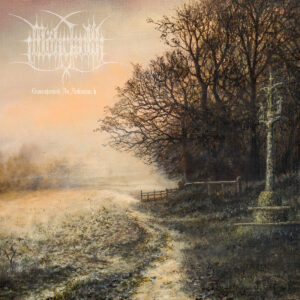 Gwenojennoù an ankounac’h—which can be translated as something along the lines of “The Paths of Oblivion”—is adorned with a beautiful canvas-painted cover rich in pastel colors. On the right stands an age-old wayside cross, set against a bare winter forest, while the left-hand side of the artwork is considerably brighter. The band’s magnificent logo can also be made out there, discreetly nestled into the scene. The whole thing is infinitely more luminous than the cover of the previous album, A-dreñv ar vrumenn, which was chiefly distinguished by its lingering mist and gray tones. I like to think that there is nothing insignificant about seeing the Bretons turn toward brighter considerations, and this can be felt in the very essence of what makes this new album so compelling.
With an almost entirely overhauled line-up—the notable exception being Vox T. on guitar—Möhrkvlth has given birth to a highly contemplative form of black metal, rich in memorable riffs and carefully crafted atmospheres. The opening minutes of “Dindan Gouloù ar C’hroajoù Mein” are exemplary in this regard: the riffs are incisive, the drumming fast, yet in the background one can savor a slightly ethereal and deeply engrossing atmosphere, perfectly supported by clean vocals of striking gravity. Overall, each track is given ample room to unfold at length and with considerable density—only the interlude “Recueillement” runs for less than seven minutes. Indeed, the album’s greatest strength lies in its sheer substance, in its fondness for carefully wrought atmospheres, and in the substantial role played by each instrument.
It would nevertheless be rather misguided to confine Gwenojennoù an ankounac’h to atmospheric black metal alone, as Möhrkvlth retains a certain roughness throughout the album. The guitars never content themselves with politely carpeting the background, and some riffs even prove surprisingly abrasive, almost surly, without ever undermining the contemplative dimension of the whole. This is probably where much of the recipe for the success of this second full-length can be found: it knows how to establish its atmospheres without succumbing to the sometimes syrupy shortcuts inherent to the style. The highly successful “Dindan Gouloù ar C’hroajoù Mein” illustrates this perfectly, as we have seen, but I would also single out “Aux Songes de l’Hiver” and its mid-tempo introduction, at once sinister and catchy. More than enough to bring the album to a close with a very natural sense of dignity.
Likewise, the pagan label seems somewhat difficult to defend here on anything other than thematic grounds. Gwenojennoù an ankounac’h is profoundly Breton in what it tells and in the imagery it summons, yet it never seeks to multiply artifices merely to remind us of this at every turn. Möhrkvlth speaks here of war, the sacred, the rural world, landscapes, and a certain memory destined to disappear. What ultimately emerges is something rather restrained in the way it pays tribute to Breton culture, without ostentatious folklore or opportunistic exoticism. And for the feverish Lille native that I am, inclined to observe all this from a corner of France where Flemish identity can only dream of boasting a tenth of the reach enjoyed by Brittany’s, this restraint is probably no small part of the album’s qualities.
Eight years ago, A-dreñv ar vrumenn did not leave an indelible impression on me, something I find difficult to explain given that its reviews were overwhelmingly positive. I am considerably more taken with Gwenojennoù an ankounac’h, which currently accompanies me through almost every one of these late-summer days. The wait has been rewarded. Those eight years probably say something about the road Möhrkvlth has traveled, but one has to admit that the period has been fruitful. One can confidently say that Gwenojennoù an ankounac’h will establish itself as one of the notable releases from the French scene this year. One small concern nevertheless remains: I sincerely hope we will not have to wait another eight years to taste the Bretons’ black metal again.
